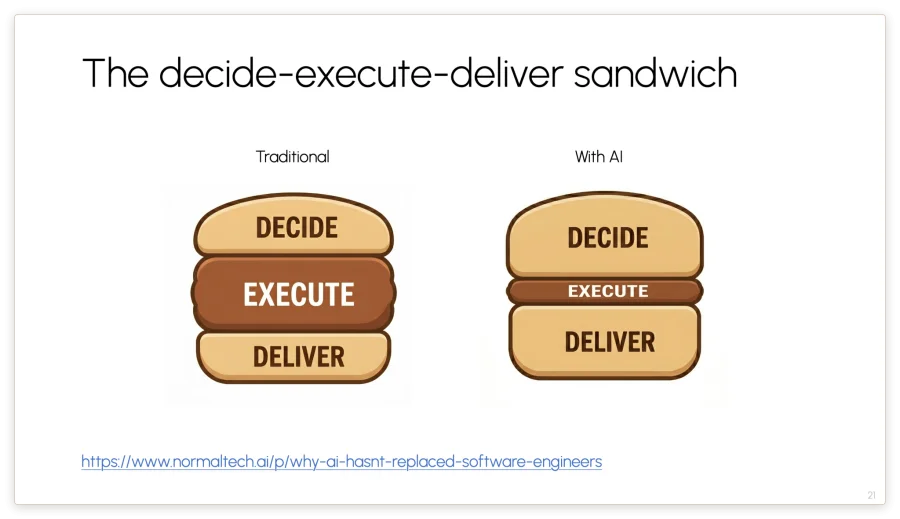

A Princeton computer scientist has a simple way to explain how artificial intelligence is changing the way we work — and it involves a hamburger.
Arvind Narayanan, a professor at Princeton University, recently keynoted the International Conference on Machine Learning in Seoul. During his talk, he showed a slide with two burgers side by side. The burger on the left, labeled “Traditional,” had a thick patty sitting between two modest buns. The burger on the right, labeled “With AI,” had a patty that had shrunk to a sliver, while the buns had grown much larger.
The patty, Narayanan explained, represents the “execute” layer of work — the coding, debugging, and hands-on tasks. The top bun represents the “decide” layer — the planning and decision-making. The bottom bun represents the “deliver” layer — the communication, deployment, and user-facing work.
The ‘Skinny Hamburger, Fat Bun’ Problem
According to Yahoo Finance, George Leimer, the company’s product chief, recognized the analogy immediately during a recent call. “It’s totally that,” Leimer said when he saw the slide.
The problem, as Narayanan sees it, is that AI is automating the core execution tasks — the “meat” of the work — at a rapid pace. This leaves workers with less hands-on work to do, but more responsibility in the decision-making and delivery layers. In other words, the “fat buns” — the decide and deliver layers — are becoming more important, while the “skinny patty” — the execute layer — is shrinking.
Why the Future of Work Needs to Look More Like a Pizza
Narayanan’s solution to this problem is to think of work not as a hamburger, but as a pizza. In a pizza, the toppings, cheese, and sauce are evenly distributed across the entire surface. There is no single “meat” layer that dominates. Instead, every slice has a balanced mix of all components.
This means that in the age of AI, workers need to develop skills across all three layers — deciding, executing, and delivering — rather than specializing only in execution. The “pizza” model suggests that work should be more evenly distributed, with AI handling the repetitive execution tasks while humans focus on the higher-level decisions and the final delivery to users.
Our Take: A Wake-Up Call for Workers and Leaders
In our view, Narayanan’s burger analogy is not just clever — it is a clear warning. For years, many workers have focused on building deep expertise in execution tasks like coding, writing, or data analysis. But AI is now doing these tasks faster and cheaper. The “skinny patty” is real, and it is shrinking.
To put it plainly, the future of work will not reward those who simply execute. It will reward those who can decide what to build and how to deliver it effectively. The pizza model is a useful way to think about this shift: instead of being a specialist in one layer, workers should aim to be generalists who can contribute across all layers.
For leaders, the message is equally clear. Companies that invest only in AI tools to automate execution — while ignoring the need for better decision-making and delivery — will end up with “fat buns” that no one can fill. The real value in the AI era will come from humans who can bridge the gap between what AI can do and what users actually need.