

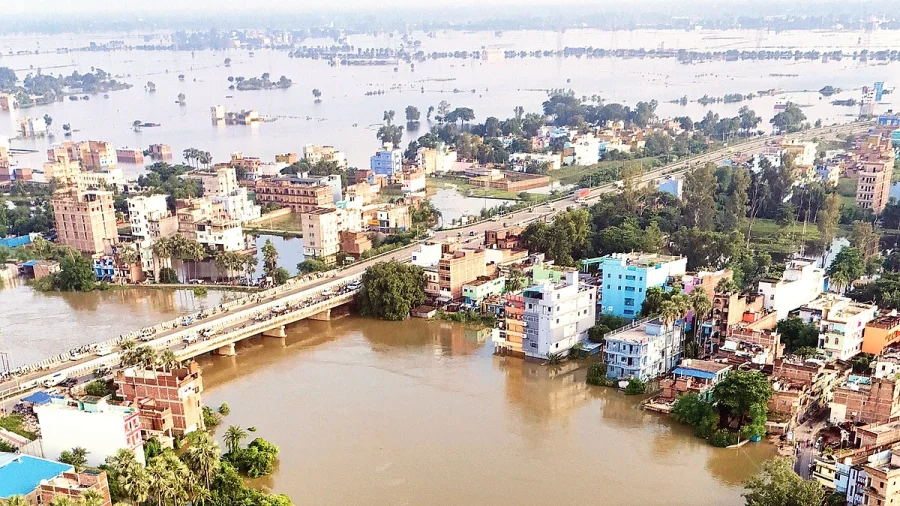

Bihar is under water again. More than 50 lakh people have been hit by floods this year. Many have been displaced from their homes. Some are living on embankments with their livestock. Others have taken shelter on highways. Some have spent days on rooftops, even treetops. A few may have died of snakebite. Others may have died of water-borne diseases. But outside Bihar, this is barely news.
The headline itself asks the uncomfortable question: is Bihar so used to floods that the rest of India has stopped paying attention? And if the media has stopped paying attention, what is it paying attention to instead? The answer, the story suggests, is advertisements.
Bihar Floods 2025: How Bad Is the Situation?
The numbers tell a grim story. Over 50 lakh people are affected. That is not a small figure. It is larger than the population of many countries. People have lost their homes, their crops, and in some cases, their lives. They are living in the open, on embankments and highways, with no proper shelter.
The story notes that some deaths have come from snakebite. Others have come from water-borne diseases. These are not rare or unexpected causes of death during floods. They are the predictable result of people being forced to live in unsafe conditions for days on end.
Yet the story points out that this is not news outside the state. The floods do not grab national headlines. The question is why.
Why Bihar Floods Don't Make National Headlines
The story offers a possible answer: floods in Bihar are such a familiar annual feature that they have stopped being considered news. When something happens every year, the media may treat it as routine rather than urgent. But for the people affected, it is not routine. It is a yearly disaster that destroys lives and livelihoods.
The story also recalls an anecdote from the mid-1990s. Celebrity American photojournalist Steve McCurry reportedly went back from flood-ravaged Bihar without taking a single photograph. For four days, he travelled through affected areas but never took out his camera, according to one of his local guides. The story asks: perhaps he can be excused, but what about Indian media?
"Are floods such a boringly familiar annual feature in the state that they fail to grab national headlines?" — the original story asks.
This is the central question. If a foreign photojournalist chose not to document the floods, that is one thing. But if Indian media consistently ignores them, that is a bigger problem. It means the suffering of millions is being normalised.
The Role of Advertisements in News Coverage
The headline mentions being "deluged by ads." This suggests that while Bihar floods, the media is flooded with advertisements. The story implies that ad-driven news coverage may be pushing out important stories like the Bihar floods.
When news organisations prioritise content that attracts advertisers, disaster coverage can suffer. Floods in Bihar may not attract the same advertising revenue as other topics. As a result, they get less airtime and fewer column inches.
- More than 50 lakh people affected by floods in Bihar this year
- Many displaced, living on embankments, highways, rooftops, and treetops
- Deaths reported from snakebite and water-borne diseases
- Floods fail to grab national headlines outside the state
- Media coverage may be influenced by advertisement-driven priorities
Our Take: Bihar Floods Deserve National Attention
In our view, the Bihar floods are not just a state issue. They are a national issue. When 50 lakh people are affected, it should be front-page news across the country. The fact that it is not says something troubling about how Indian media decides what matters.
To put it plainly, floods in Bihar are treated as a seasonal event that will pass. But for the people living through them, they do not pass. They lose homes, livestock, and sometimes family members. The media's silence makes their suffering worse.
The story's comparison to Steve McCurry is telling. If even a celebrated photojournalist chose not to document the floods, it reflects a broader attitude: that this is not worth seeing. But it is worth seeing. It is worth reporting. It is worth remembering.
Readers should ask themselves: why do some disasters get wall-to-wall coverage while others are ignored? The answer often lies in what attracts advertisers, not what affects the most people. That is a problem we should all be concerned about.
The Bihar floods are a reminder that familiarity can breed indifference. But indifference is not an option when millions are suffering. The media must do better. And readers must demand better.


