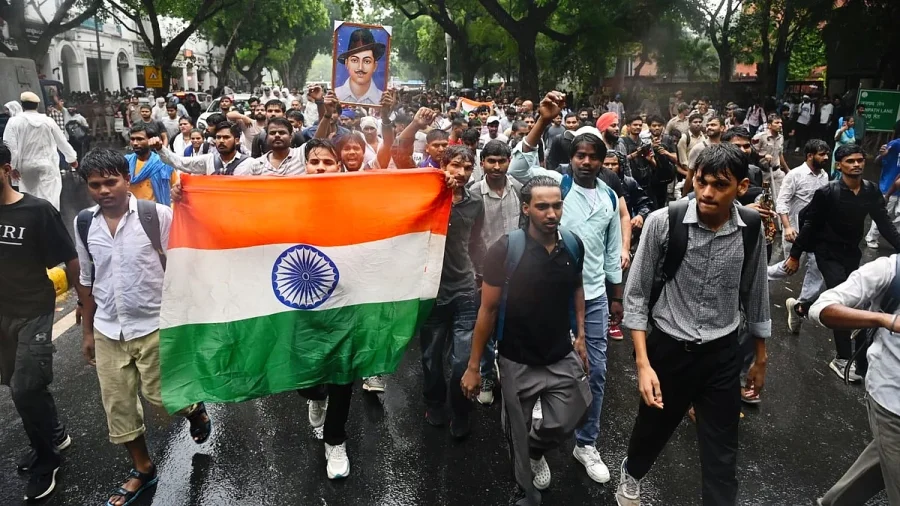

A first-person account circulating on social media has captured a striking scene in central Delhi. It describes a "sea of people" — a vibrant wave of protesters demanding change and accountability. The account notes that while there were sporadic incidents of lathi charge and some protesters were forced into buses, the march was largely peaceful. Carrying the national flag, copies of the Constitution, and photos of Ambedkar, Mahatma Gandhi, and Bhagat Singh, the crowd moved forward with slogans like "Bharat Mata ki Jai" and "Vande Mataram."
Peaceful March Towards Parliament
The account describes how the police mingled with the crowd and moved forward with them. The protesters were simply walking towards Parliament, with no use of force or violence against the police. This scene continued up until Sansad Marg police station, where more buses were stationed. The description paints a picture of a determined but non-violent citizenry exercising their democratic right to protest.
The Core Question: 'Daro Mat'
The headline of the original story asks a pointed question: "Is the government scared that people are no longer scared?" The phrase "Daro mat" — meaning "Don't be afraid" — seems to be a message to the government itself. The implication is that the government has relied on fear to maintain control, and the sight of unafraid citizens marching peacefully challenges that dynamic.
Our Take: Fear as a Political Tool
To put it plainly, the question raised by this protest is a powerful one. Governments often thrive on a certain level of public fear — fear of authority, fear of consequences, fear of instability. When citizens lose that fear and come out in large numbers, peacefully and with the Constitution in hand, it signals a shift in the power balance. In our view, the government's reaction — whether through lathi charges or forced busing — suggests it is indeed unsettled by this newfound courage. The real test is whether the government will listen to the demands of these unafraid citizens or continue to rely on intimidation. The answer will define the future of democratic accountability in India.