
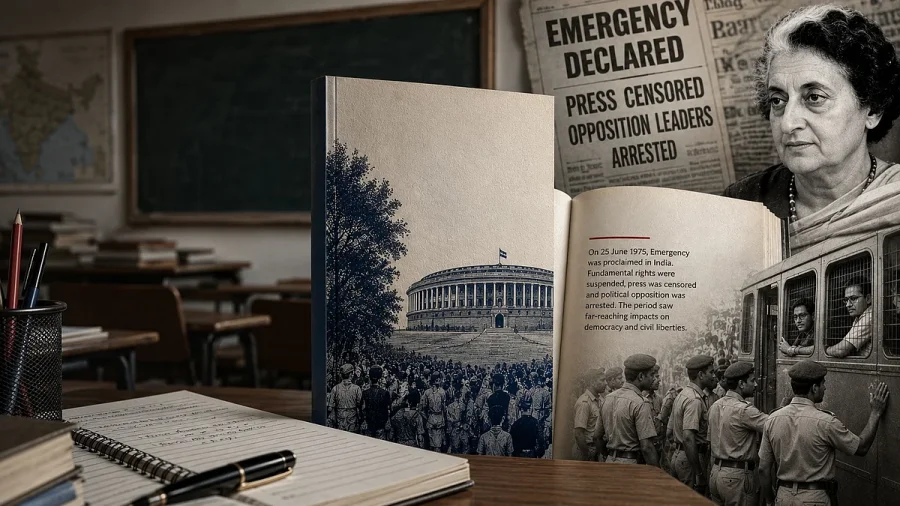

The National Council of Educational Research and Training (NCERT) has released a new Social Science textbook for Class IX titled Understanding Society, India and Beyond: Part 1. For the first time, the book includes a dedicated section on the Emergency — the period between 1975 and 1977 when then-Prime Minister Indira Gandhi suspended civil liberties.
The textbook was released on June 25, 2026 — exactly 51 years after the Emergency was imposed. The section appears under the heading 'Challenges to Democratic Practices in India' within a broader chapter on 'Democracy'. This marks the first time the Emergency has been given its own space in the Class IX curriculum.
Education Minister Defends the Move
Union Education Minister Dharmendra Pradhan has strongly defended the decision. According to National Herald, Pradhan argued that future generations must learn about the 'dark deeds' of the Emergency so that such events are never repeated. He framed the inclusion as a necessary lesson in democratic vigilance.
While the stated intent — to confront a difficult chapter in India's history — appears commendable, the timing and framing of the move have raised questions. Critics argue that the choice of release date, the 51st anniversary of the Emergency, is not a coincidence. It suggests a political message rather than a purely educational one.
Questions Over Pedagogical Approach
The core concern is not whether the Emergency should be taught — most scholars agree it should be — but how it is being taught. The framing of the chapter within 'Challenges to Democratic Practices' could shape how students understand the event. If the narrative is one-sided or overly simplified, it risks becoming a tool for partisan pedagogy rather than a balanced historical lesson.
According to National Herald, the article notes that no scholar worth his salt disputes the enormity of the Emergency. The problem is not the inclusion of the topic, but the way it is presented. A textbook that frames the Emergency as a simple story of 'dark deeds' versus 'democratic heroes' may fail to teach students the complexity of how democracies can falter.
"While the intent to confront history appears commendable, the timing, framing and pedagogical approach suggest a deeper political purpose that risks undermining the educational value of the lesson." — National Herald
The Risk of Politicising the Classroom
The debate over the Emergency chapter is part of a larger conversation about the role of politics in education. When a government decides what history to teach and how to frame it, there is always a risk that the curriculum becomes a tool for political messaging rather than a space for critical thinking.
In this case, the NCERT's decision has been met with both support and skepticism. Supporters say it is important for young Indians to know about the darkest period in the country's democratic history. Critics worry that the chapter could be used to score political points rather than to educate.
The key question is whether the textbook allows students to think critically about the Emergency — its causes, its consequences, and the lessons it holds for democracy — or whether it simply presents a one-sided narrative that serves a political agenda.
Our Take: History Lessons Should Not Be Political Weapons
Teaching the Emergency in schools is a good idea. It is a significant event in India's democratic history, and students should understand it. But the way it is taught matters just as much as the fact that it is taught.
In our view, the timing of the release — on the anniversary of the Emergency — and the framing of the chapter raise legitimate concerns. When a government chooses a politically charged date to release a textbook, it sends a message. That message may be about the importance of democracy, or it may be about targeting political opponents. The line between education and propaganda is thin.
To put it plainly: if the NCERT wants to teach the Emergency, it should do so in a way that encourages students to ask questions, not just accept a pre-packaged narrative. A textbook that tells students what to think about the Emergency, rather than helping them think for themselves, is not education — it is indoctrination.
The real test will be in the classroom. Will teachers be free to discuss the Emergency from multiple perspectives? Will students be encouraged to debate its causes and consequences? If the answer is yes, then this could be a valuable addition to the curriculum. If the answer is no, then the NCERT has simply turned the classroom into a political battleground.