
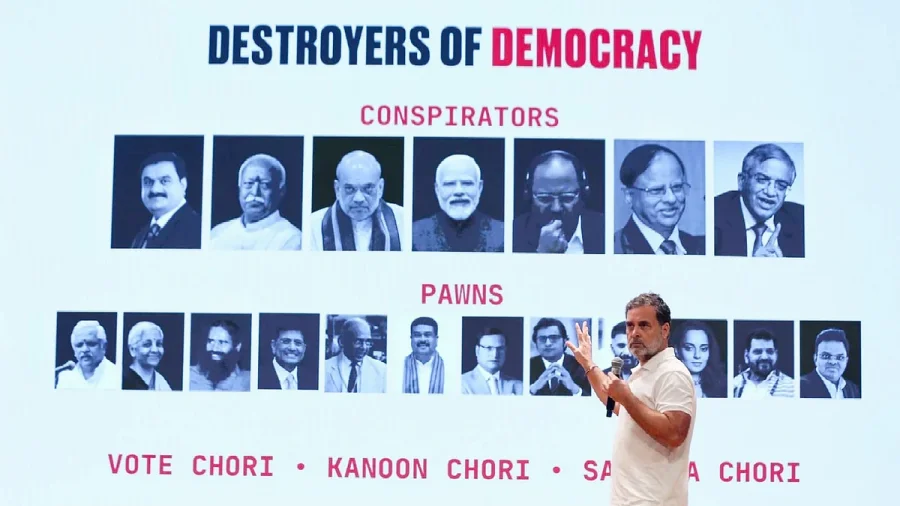

Congress leader Rahul Gandhi has called Prime Minister Narendra Modi, Union Home Minister Amit Shah and Chief Election Commissioner Gyanesh Kumar "deshdrohis" (traitors). He accused them of "destroying" India's vote and demanded that the CEC resign immediately.
Gandhi, who is the Lok Sabha Leader of Opposition, made these remarks while speaking to the press. He said he was "100 per cent sure" that elections in the country were being rigged.
What Rahul Gandhi Said About the CEC and the Election Process
The Congress leader directed his sharpest demand at CEC Gyanesh Kumar. He said Kumar must quit his post immediately. He also suggested that the CEC should turn approver — a term usually used for someone who cooperates with investigators in a criminal case.
Gandhi claimed that Modi and Shah were "at the top" of what he described as an electoral conspiracy. In his view, the three leaders together had damaged the sanctity of the vote.
He also questioned what he called the disappearance of anti-incumbency. Anti-incumbency is the natural voter fatigue that builds up against a sitting government over time. Gandhi's point was that this sentiment had somehow vanished from the electoral picture, and he linked that to his rigging allegation.
Why This Charge Matters
This is not a routine political attack. Calling a sitting Prime Minister, a Home Minister and the country's top election official "traitors" is a serious escalation in political language.
The Election Commission of India is the body that conducts and supervises elections. The Chief Election Commissioner heads that body. When a senior opposition leader questions the CEC's integrity and asks him to resign, it raises questions about public trust in the election process itself.
The demand that the CEC "turn approver" is also unusual. It suggests Gandhi wants Kumar to reveal what he claims to know about the alleged conspiracy. So far, no evidence has been presented publicly by Gandhi to back these claims.
Our Take: Strong Words Need Strong Proof
In our view, the language used here is extreme. Words like "traitor" carry heavy meaning in any democracy. They should not be thrown around unless there is solid, verifiable proof behind them.
At the same time, the allegations are serious enough that they deserve a serious response. If Rahul Gandhi believes elections are being rigged, he should present the evidence in public or in court — not just at press conferences. A claim of being "100 per cent sure" is not the same as showing proof.
For the government and the Election Commission, silence is not a good answer either. When the country's top election official is called a traitor by the Leader of Opposition, the ECI should come forward and address the charges directly. Voters deserve to know whether these allegations have any basis.
To put it plainly — Indian democracy runs on trust. If that trust is damaged from either side, whether by reckless accusations or by unanswered questions, it is the ordinary voter who loses. Both sides need to act responsibly. The opposition must show proof. The government and the ECI must answer. That is the only way this debate moves forward.