
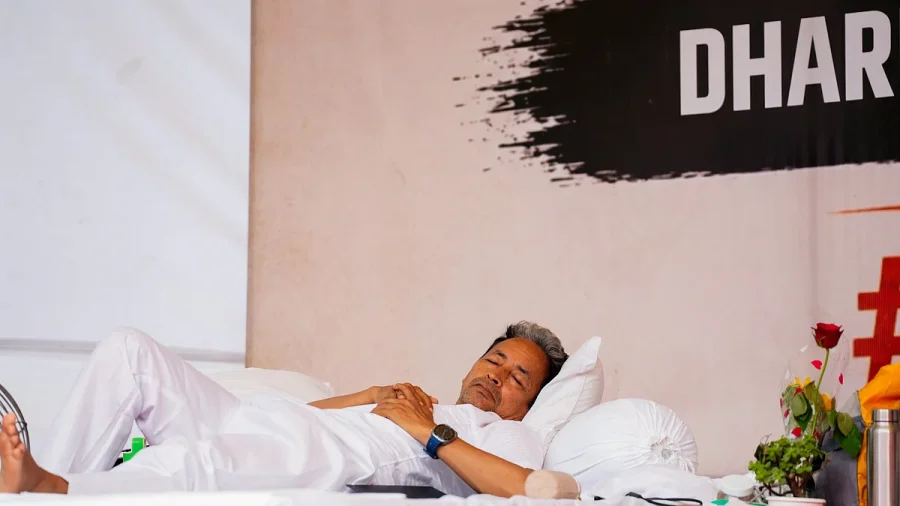

Educationist and climate activist Sonam Wangchuk's hunger strike at Delhi's Jantar Mantar entered its sixth day on Friday. The Cockroach Janta Party (CJP) said the activist's health had deteriorated further and appealed to supporters across the country to observe a one-day fast in solidarity with the protest.
Health Update on Day 6 of Wangchuk's Hunger Strike
According to National Herald, CJP founder Abhijeet Dipke posted a health update on X. He said Wangchuk's blood pressure was 110/75 mmHg, pulse rate 72 beats per minute, and blood sugar level 61 mg/dL.
Dipke noted that Wangchuk appeared "far weaker and more exhausted" than in previous days. However, the activist himself maintained that he was doing fine.
"It is Day 6 of Sonam Wangchuk's hunger strike. Today, he looks far weaker and more exhausted than he did a few days ago. For the first time, I could see the pain..." — Deccan Herald
CJP Calls for Nationwide Solidarity Fast
The Cockroach Janta Party (CJP) has called on supporters across the country to observe a one-day fast in solidarity with Wangchuk's protest. The call was made by CJP founder Abhijeet Dipke, as reported by Udayavani.
The protest is part of a larger movement demanding reforms in the education system, particularly related to exam policies. Wangchuk's hunger strike has drawn attention to these issues over the past six days.
Our Take: A Test of Resolve and Public Support
Sonam Wangchuk's hunger strike entering its sixth day with clear signs of physical decline is a serious development. The CJP's call for a nationwide solidarity fast is a strategic move to keep public attention on the core demands. In our view, the coming days will be critical — both for Wangchuk's health and for whether the protest can translate into tangible policy action. The government's response, or lack of it, will determine if this becomes a turning point for education reform in India.