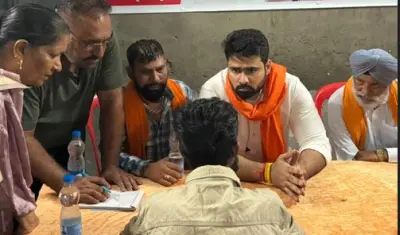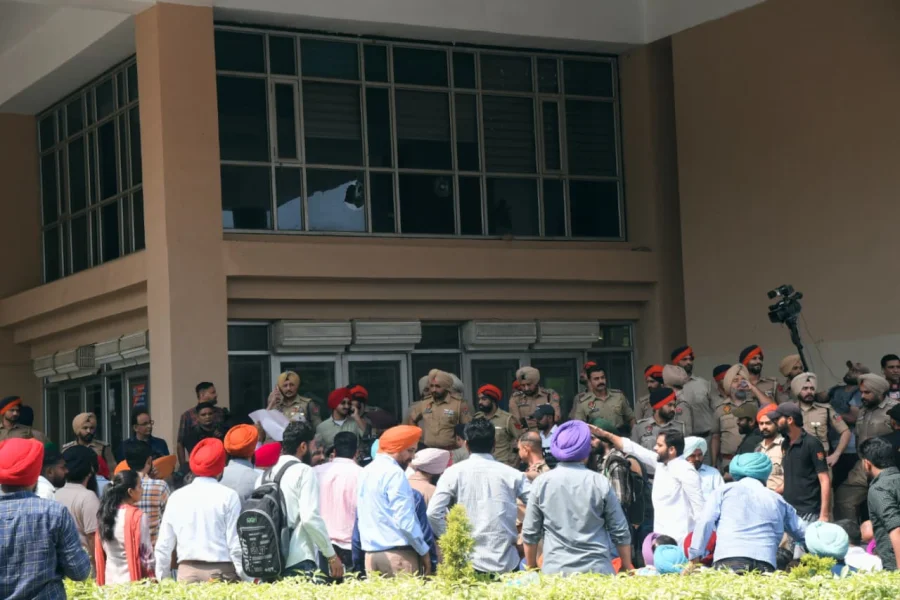

Aam Aadmi Party leaders and workers gheraoed the Greater Mohali Area Development Authority (GMADA) office in Mohali, where Enforcement Directorate teams had been conducting search operations since Tuesday morning. Around 400 AAP leaders and workers gathered outside the office and raised slogans against the BJP, alleging that the ED action was aimed at putting pressure on the Punjab government ahead of the Assembly elections.
AAP Leaders Lead Protest at GMADA Office in Mohali
The protest was led by AAP's state working president Amansher Singh Sherry Kalsi, along with MLA Chetan Singh Jouramajra and S S Ahluwalia. AAP workers held placards and raised slogans against the BJP and the ED. The party's core allegation is straightforward — that the ED raids are not routine enforcement but a political move designed to pressure the Punjab government before elections.
Why AAP Says the ED Raids Are Political Pressure
The AAP's position is that the timing of the ED search operations at the GMADA office is not a coincidence. With Assembly elections approaching in Punjab, the party argues that the raids are meant to create pressure on the state government. The protest at the GMADA office was a direct response to the ED teams' presence there since Tuesday morning.
The party has framed this as a fight against what it calls political pressure on Punjab. The presence of senior AAP leaders — including the state working president and an MLA — at the gherao shows the party is treating this as a major political issue, not just a routine administrative matter.
Our Take: This Is a Political Battle, Not Just a Raid
To put it plainly, this is no longer just about an ED search operation at a government office. It has become a direct political confrontation between AAP and the BJP-led central agencies ahead of Punjab elections. The AAP's decision to gherao the GMADA office with 400 workers and senior leaders is a clear signal that the party wants to turn this into an election issue.
In our view, the real question is not whether the ED has the right to conduct searches — it does. The question is whether the timing and targeting of these raids are being used to influence voters before they cast their ballots. The AAP is betting that voters will see this as political interference. The BJP, by not responding directly to the protest, is letting the ED action speak for itself.
For readers in Punjab, this matters because it sets the tone for the coming election campaign. If the AAP can successfully frame the ED raids as political pressure, it could gain sympathy votes. If the raids uncover genuine wrongdoing, that narrative collapses. Either way, the GMADA office gherao is a preview of the political fight ahead.
The AAP has made its stand clear — it will not let ED actions go unchallenged on the ground. Whether that strategy works will be decided by voters, not by slogans.