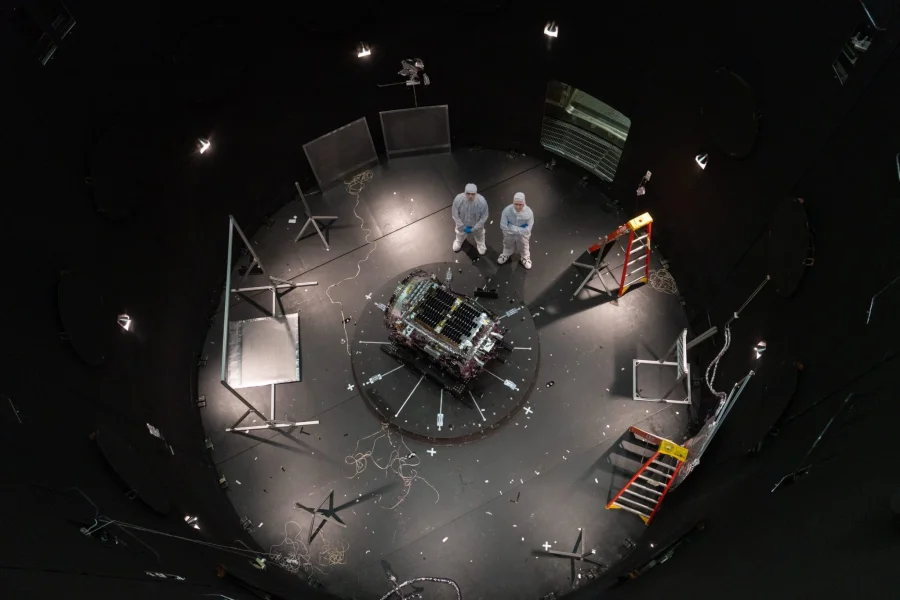

NASA is racing against time to save an aging space telescope from falling back to Earth. The agency has hired startup Katalyst Space Technologies to launch a daring robotic rescue mission that could begin as early as this week.
The target is the Swift Observatory, a space telescope that has been scanning the cosmos for explosions since its launch in 2004. According to AP News via ExpressNews, the $30 million salvage operation is set to launch from an atoll in the Pacific's Marshall Islands aboard an airplane-launched Pegasus rocket. Liftoff could occur as early as Tuesday.
Why Swift Needs a Rescue
Swift has been sinking faster and faster in its orbit due to recent intense solar activity. The telescope needs to be moved to a higher, more stable orbit to continue its mission of hunting for some of the universe's biggest explosions — including gamma-ray bursts and other high-energy events.
According to ABC News, this is a first-of-its-kind mission that will attempt to save an aging space telescope using a robot spacecraft. The three-armed spacecraft built by Katalyst will chase after Swift once it takes off.
How the Robotic Rescue Will Work
The plan involves a robotic spacecraft designed by Katalyst Space Technologies that will dock with Swift and boost it to a higher orbit. This approach is unprecedented for a telescope that was never designed to be serviced in space.
As reported by Space.com, "No one thought it was going to be possible" — highlighting the ambitious nature of the mission. The telescope is literally falling out of space, and this is NASA's daring plan to save it.
Hubble Could Be Next
The success of this mission could have major implications for other aging space telescopes — most notably the legendary Hubble Space Telescope. If the Swift rescue works, a similar robotic servicing mission could be used to extend Hubble's life as well.
According to discussions on Reddit, NASA has previously said Hubble will be able to operate until 2035, but with reduced performance — unless a crewed servicing mission is performed. A robotic rescue like the one planned for Swift could offer a cheaper alternative.
Our Take: This Is the Future of Space Maintenance
This mission matters far beyond just saving one telescope. If Katalyst's robotic spacecraft can successfully boost Swift to a higher orbit, it opens the door for a whole new industry — in-space servicing and maintenance.
For decades, satellites and telescopes have been disposable. Once they run out of fuel or their orbit decays, they either burn up in the atmosphere or become space junk. That model is wasteful and expensive. A successful rescue of Swift would prove that we can extend the life of valuable space assets without sending astronauts.
And the implications for Hubble are enormous. The telescope that revolutionized astronomy is slowly dying in orbit. A robotic rescue mission could give it another decade or more of life — at a fraction of the cost of building and launching a replacement.
To put it plainly: If this works, we may look back at the Swift rescue as the moment space maintenance became routine. That would be a game-changer for the entire space industry.