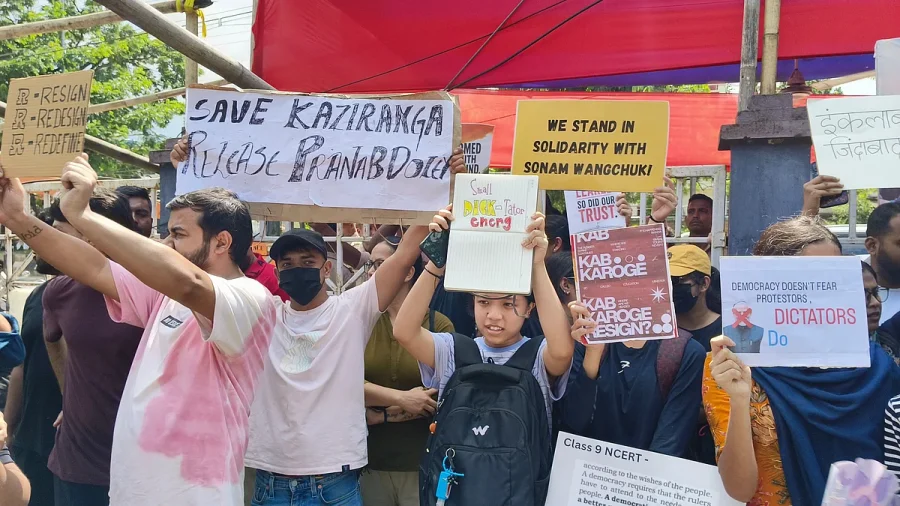

The Assam government has invoked the stringent National Security Act (NSA) against indigenous rights and environmental activist Pranab Doley, just a day after he secured bail in a case linked to protests against a proposed five-star hotel near Kaziranga National Park.
Doley, who was arrested in Guwahati on 13 July and lodged in Golaghat district jail, was granted bail by a court on 29 July in connection with the June protest. However, before he could walk free, the state government moved to keep him detained under the preventive detention law.
NSA invoked after bail in Kaziranga hotel protest case
The order, issued by the Political (A) Department, stated that the government was satisfied that Doley's activities were "prejudicial to the maintenance of public order as well as security of the state" and that there was a "real and imminent" threat. According to National Herald, the preventive detention law was invoked a day after Doley's bail in the case.
The 1980 NSA Act allows the government to detain an individual without a trial or formal charges for up to 12 months, as reported by The New Indian Express. This means Doley will remain in the same jail despite the court granting him bail.
What led to Pranab Doley's arrest and detention
The case against Doley stems from protests in June against a proposed five-star hotel near Kaziranga National Park, a UNESCO World Heritage site known for its one-horned rhinoceros population. Doley, described as an indigenous land rights activist, was part of the opposition to the project.
According to The Indian Express, a court granted bail to Doley in a 29 July order. The timing of the NSA invocation — immediately after the bail order — has raised questions about the sequence of legal actions.
"The Assam government has invoked the National Security Act (NSA) against indigenous land rights activist Pranab Doley, a day after a local court granted him bail." — Guwahati Plus
Legal implications of NSA detention without trial
The NSA is a preventive detention law that permits authorities to hold individuals without formal charges or a trial. This is a significant escalation from the earlier case, where Doley had been granted bail by a judicial court.
Under the NSA, the government can detain a person for up to 12 months if it believes their actions threaten public order or state security. The order against Doley specifically cited his activities as being prejudicial to both public order and the security of the state, as detailed in the government's official communication.
This development has drawn attention to the use of preventive detention laws in environmental and land rights activism. The case highlights the legal tools available to state governments when dealing with protests and civil disobedience.
Our Take: A concerning precedent for activism
To put it plainly, this sequence of events raises serious concerns. A court examined the case against Pranab Doley and decided he deserved bail. Within hours, the executive branch of the government overrode that judicial decision using a law designed for exceptional circumstances.
The NSA is meant for cases where there is a genuine, imminent threat to national security. Using it against an activist involved in peaceful protests over a hotel project near a national park stretches that definition considerably. In our view, this sends a troubling message to civil society — that even lawful protest, followed by a court granting bail, can result in indefinite detention without trial.
This is not about whether one agrees with Doley's cause. It is about whether the state should use its most powerful preventive detention tool against citizens exercising their right to protest. The fact that the NSA was invoked the very next day after bail suggests a deliberate decision to keep him in custody regardless of judicial process.
Readers should watch this case closely. It sets a precedent for how environmental activism and land rights movements are handled in Assam — and potentially across the country.
Sources & References
- National Herald — Assam invokes NSA against Kaziranga activist Pranab Doley after he gets bail
- The New Indian Express — Rights activist held under NSA after bail in case over protesting against Kaziranga hotel
- The Indian Express — NSA invoked by Assam against activist Pranab Doley day after he gets bail
- Guwahati Plus — NSA invoked against Pranab Doley
- Rediff — Assam Slaps NSA On Kaziranga Protest Leader After Bail