

Summary
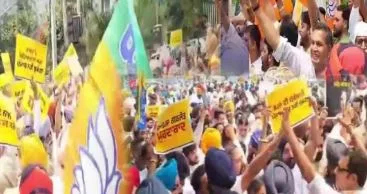
Political tension rose in Bathinda on Sunday as members of the Bharatiya Janata Party (BJP) and the Aam Aadmi Party (AAP) held rival protests. The groups came face-to-face near the BJP office following the arrest of Punjab Cabinet Minister Sanjeev Arora. The Enforcement Directorate (ED) took the minister into custody on Saturday in connection with a money laundering investigation. This event led to a heated standoff that required a large police presence to prevent physical violence between the two political groups.
Main Impact
The arrest of a sitting cabinet minister has caused a major political storm in Punjab. The clash in Bathinda shows how deeply the state is divided over the actions of federal agencies. While the BJP sees the arrest as a necessary step against corruption, the AAP views it as a political attack. This disagreement has moved from government offices to the streets, causing public disruption and putting local police on high alert. The situation has forced law enforcement to use significant resources to maintain order in busy city areas.
Key Details
What Happened
The trouble began on Sunday afternoon near Mittal Mall in Bathinda. BJP activists gathered to celebrate the arrest and demand further action against the state government. At the same time, AAP workers and leaders arrived to show their support for Sanjeev Arora. The two groups met outside the BJP district office, leading to loud shouting and a tense atmosphere. Police officers had to act quickly to keep the two sides apart. They formed a human chain to ensure that the protesters did not get close enough to hurt each other.
Important Numbers and Facts
The Enforcement Directorate arrested Sanjeev Arora in Chandigarh on Saturday. On Sunday, the protest in Bathinda involved several high-ranking police officials, including SP Narinder Singh and two DSPs, Amritpal Singh Bhaati and Arun Mundan. Many prominent AAP leaders were present, including four members of the Legislative Assembly (MLAs): Jagroop Singh Gill, Balkar Sidhu, Jagsir Singh, and Sukhveer Singh Maiserkhana. The BJP side was led by Sarup Chand Singla, the party’s district president and a former MLA. The AAP had called for similar protests at BJP offices in every district across Punjab on the same day.
Background and Context
This conflict is rooted in a case involving money laundering. Money laundering is a term used when someone tries to hide the source of money that was obtained illegally. The Enforcement Directorate is the federal agency in India responsible for investigating these types of financial crimes. In recent months, there have been several high-profile cases involving politicians from various parties. This has led to a heated debate about whether these investigations are based on facts or if they are used to pressure political rivals. In Punjab, the relationship between the ruling AAP and the opposition BJP has been strained for a long time, and this arrest has made the situation even more difficult.
Public or Industry Reaction
The reaction from both sides was immediate and strong. BJP supporters raised slogans against Chief Minister Bhagwant Singh Mann and the arrested minister. They argued that the government has lost its right to lead on moral grounds and should resign. They believe the arrest proves that there is corruption within the state leadership. On the other side, AAP workers directed their anger toward Prime Minister Narendra Modi and the central government. They accused the BJP of being "anti-Punjab" and claimed that the ED is being used as a tool to weaken their party. The local public in Bathinda faced some inconvenience as the area near the mall was crowded with protesters and police vehicles for several hours.
What This Means Going Forward
The political climate in Punjab is likely to remain tense for the foreseeable future. Since the AAP has called for statewide protests, we can expect to see more gatherings outside BJP offices in other cities. This could lead to more work for the police and potential traffic issues for residents. For the state government, the arrest of a cabinet minister is a significant challenge. They will need to manage the legal case while also trying to keep their supporters motivated. Meanwhile, the BJP will likely continue to use this case to question the integrity of the AAP government as they look toward future elections. The court proceedings for Sanjeev Arora will be the next major event to watch.
Final Take
The events in Bathinda highlight the growing gap between political parties in Punjab. When legal actions turn into street protests, it shows that the battle is about more than just a single court case. It is a fight over public trust and political power. As both sides refuse to back down, the role of the police in keeping the peace becomes more important than ever. The coming days will reveal how this arrest affects the stability of the state's political environment.
Frequently Asked Questions
Why was Sanjeev Arora arrested?
Sanjeev Arora was arrested by the Enforcement Directorate (ED) in connection with a money laundering case. The agency is investigating financial dealings that they believe involve illegal activities.
Who participated in the Bathinda protests?
The protests involved members of the BJP and the AAP. High-level leaders, including several MLAs from the AAP and former officials from the BJP, were present at the scene along with many party workers.
What was the role of the police during the clash?
The police were there to maintain law and order. They formed a human chain to separate the two groups of protesters and prevent any physical fights from breaking out near the BJP office.
