

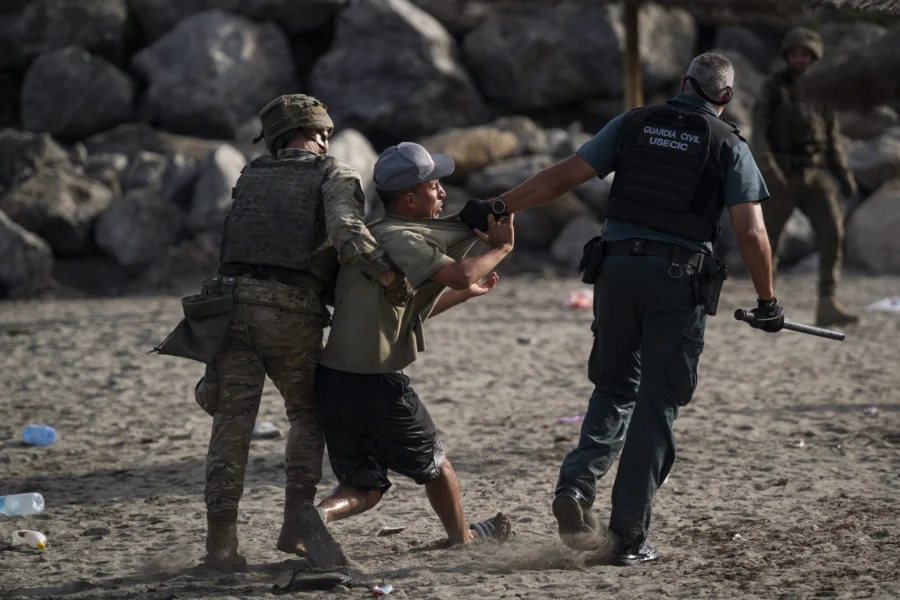

Spain has installed a 500-meter-long (1,600-foot) barrier on the sea border between its North African territory of Ceuta and neighboring Morocco. The move comes after tens of thousands of migrants breached the frontier earlier in the week, creating a crisis that has now drawn sharp criticism from other European Union leaders.
Spain's Sea Barrier Response to Mass Migrant Crossings
According to Fortune, Spain added the barrier between Ceuta and Morocco after EU states warned about "uncontrolled mass crossings." The containment barrier is designed to prevent migrants from entering Spanish territory by sea.
The installation follows a chaotic week in which tens of thousands of migrants attempted to enter Ceuta. The Spanish government confirmed Saturday that at least 67 migrants died during the events. Some drowned while attempting the crossing, while others were killed in a stampede as they tried to cross a breakwater barrier.
Deadly Toll and Desperate Arrivals at Tarajal Beach
The human cost of the crisis became clear as exhausted migrants who swam to Ceuta's urban Tarajal beach arrived Saturday morning. The Spanish government's confirmation of 67 deaths highlights the dangerous conditions migrants faced during their attempts to reach Spanish territory.
According to News 4 Buffalo, Spain announced it was installing the 500-meter-long (1,600-foot) containment barrier on the sea border. The barrier represents a physical response to the unprecedented surge in migration attempts.
PM Sánchez Hits Back at EU Critics Over Schengen Suspension Calls
Spanish Prime Minister Pedro Sánchez did not hold back in his response to other European Union leaders who reacted harshly to the events in Ceuta. Some EU leaders called for Spain to be suspended from the EU's borderless Schengen zone, a move that would have significant consequences for travel and border policy across Europe.
"Driven by prejudice, fake news, ignorance, or political interest." — Fortune
Sánchez dismissed these calls as politically motivated rather than based on facts. His sharp rebuke signals growing tension between Spain and other EU member states over how to handle migration pressure at Europe's southern borders.
EU States Warn Against Uncontrolled Mass Crossings
The EU states' warning about "uncontrolled mass crossings" reflects broader concerns across Europe about migration flows. The situation in Ceuta has become a flashpoint in the ongoing debate about border security and migration policy within the European Union.
- Spain installed the barrier on Saturday in direct response to the migrant surge
- The crisis has created diplomatic friction between Spain and other EU members
- Ceuta remains a key entry point for migrants attempting to reach European soil
Our Take: A Crisis That Demands European Unity, Not Division
To put it plainly, this crisis reveals a troubling split within the European Union. When one member state faces a migration emergency, the response from others should be solidarity, not threats of suspension. The calls to remove Spain from the Schengen zone are not just unhelpful — they are dangerous.
The deaths of at least 67 migrants should be the focus here. These were people fleeing difficult circumstances, and their deaths on Europe's doorstep should prompt reflection, not political point-scoring. PM Sánchez is right to call out the "prejudice" and "fake news" driving some EU reactions.
At the same time, the barrier itself raises questions. Physical barriers have historically done little to stop determined migrants — they simply push them toward more dangerous routes. The real solution requires a coordinated European approach to migration that addresses root causes and shares responsibility fairly.
For now, Spain has taken immediate action to secure its border. But the deeper issue — how Europe responds to migration pressure collectively — remains unresolved. The coming weeks will show whether EU leaders can move beyond blame and work toward a common solution.